Commercial Air Duct Cleaning in Colorado: How Cleaner HVAC Systems Protect Your People, Property & Bottom Line
Share on:
Facebook
Twitter
LinkedIn
Key Takeaways
Poor indoor air quality in Colorado commercial buildings can lead to health complaints, dust buildup, lingering odors, and higher energy bills. Commercial air duct cleaning helps reverse these issues by removing contamination from the HVAC system before it continues to circulate through occupied spaces.
Bee’s Air Duct Cleaning provides NADCA-compliant commercial HVAC system cleaning and air duct cleaning services for offices, schools, warehouses, medical facilities, and other commercial buildings across the Colorado Front Range.
Dirty air ducts can circulate dust, allergens, mold spores, smoke residue, dirt, and other airborne contaminants linked to sick building syndrome, absenteeism, and customer discomfort.
Regular commercial air duct and dryer vents cleaning improves air quality, restores airflow, boosts hvac efficiency, reduces odors, and helps create a healthier, cleaner environment while lowering operational costs.
To request a commercial air duct inspection or quote, contact Bee’s Air Duct Cleaning for professional solutions tailored to your facility.
How Poor Indoor Air Quality Impacts Colorado Commercial Buildings
Indoor air quality, or IAQ, describes the condition of the air inside commercial buildings and how it affects comfort, health, and performance. The Environmental Protection Agency ranks indoor air pollution among the top five environmental risks to public health, highlighting the importance of maintaining good indoor air quality. The Environmental Protection Agency (EPA) ranks indoor air pollution among the top five environmental risks to public health, highlighting the importance of professional air duct cleaning services in commercial settings.
Colorado adds extra pressure. Dry air, high pollen, road dust, and wildfire smoke from events like the Cameron Peak and East Troublesome fires can load ventilation systems with fine particles. Poor Indoor Air Quality (IAQ) can trigger building-related illnesses, impacting staff health and productivity.
Airborne contaminants include dust, paper fibers, fabric fibers, vehicle exhaust, warehouse particulates, pollen, mold spores, and VOCs. Contaminated air ducts contribute to poor indoor air quality, which can adversely affect employee health and productivity, leading to absenteeism and lost productivity for businesses. Contaminated air ducts can lead to poor indoor air quality, which adversely affects employee health, productivity, and satisfaction in commercial environments.
Common complaints include headaches, dry throat, coughing, itchy eyes, fatigue, and respiratory irritation that worsen during work hours. This pattern is often described as sick building syndrome, especially in older offices, schools, and retail centers with original ductwork, restricted airflow, and trapped pollutants.
What Builds Up Inside Commercial Air Ducts & HVAC Systems
Commercial HVAC often runs 10–18 hours per day, pulling air through returns, coils, air handlers, and ducts. Over time, debris accumulates in HVAC systems, which can lead to decreased efficiency and increased energy costs as the system has to work harder to maintain comfort levels.
Typical buildup includes construction dust from tenant improvements, copier and printer particles, cardboard dust from warehouses, metal or wood dust from light manufacturing, and biological contaminants like bacteria and mold spores. Colorado’s low humidity allows fine dust to stay airborne longer, enter return vents, and settle on internal components.
Trapped moisture in ducts fosters mold and mildew, producing unpleasant odors that can be neutralized through professional remediation. Snow-melt leaks, roof intrusions, condensation, drain pans, and dirty insulation can all create microbial risk.
As debris accumulates, it narrows air ducts, clogs coils, and restricts airflow. Excess airborne particulate matter that accumulates in ductwork can strain internal HVAC components. Dust accumulation on internal HVAC components can cause excess wear and tear, potentially leading to costly emergency breakdowns.
Business Risks of Ignoring Dirty Air Ducts in Commercial Facilities
For Colorado commercial clients, neglected air ducts create avoidable business risk. That includes corporate offices, schools, clinics, warehouses, fitness centers, restaurants, and industrial properties.
Health-related impacts can include aggravated asthma, allergies, COPD symptoms, immune-system concerns, and complaints from parents, patients, tenants, or employees about air quality. Cleaning significantly reduces airborne contaminants, leading to fewer sick days and a healthier environment. Maintaining clean ductwork impacts employee health, workplace productivity, operational costs, and equipment lifespan.
Operationally, dirty ducts force HVAC units to work harder to maintain temperatures, restoring optimal airflow can lower utility bills. Regular HVAC maintenance is essential for peak efficiency, safety, and long-term equipment performance, as heating and cooling can account for up to 50% of total energy use in many homes and commercial buildings.
Regular commercial duct cleaning ensures compliance with air cleanliness standards enforced by local and federal agencies. Schools, healthcare spaces, and high-sensitivity environments also face stronger expectations around comfort, ventilation, safety, and documentation.
For customer-facing facilities, the signs are immediate:
Musty smells and stale commercial air
Visible dust on vents and surfaces
Complaints about hot/cold zones
Odors that make customers question cleanliness
A higher risk that neglected vents become fire hazards, particularly in high-sensitivity environments
How Commercial Air Duct Cleaning Improves Indoor Air Quality & HVAC Performance
Commercial air duct cleaning is a source-removal process. Instead of masking odors, it physically extracts dust, debris, allergens, and contaminants from the entire HVAC system, including return and supply ductwork, coils, blowers, registers, and diffusers.
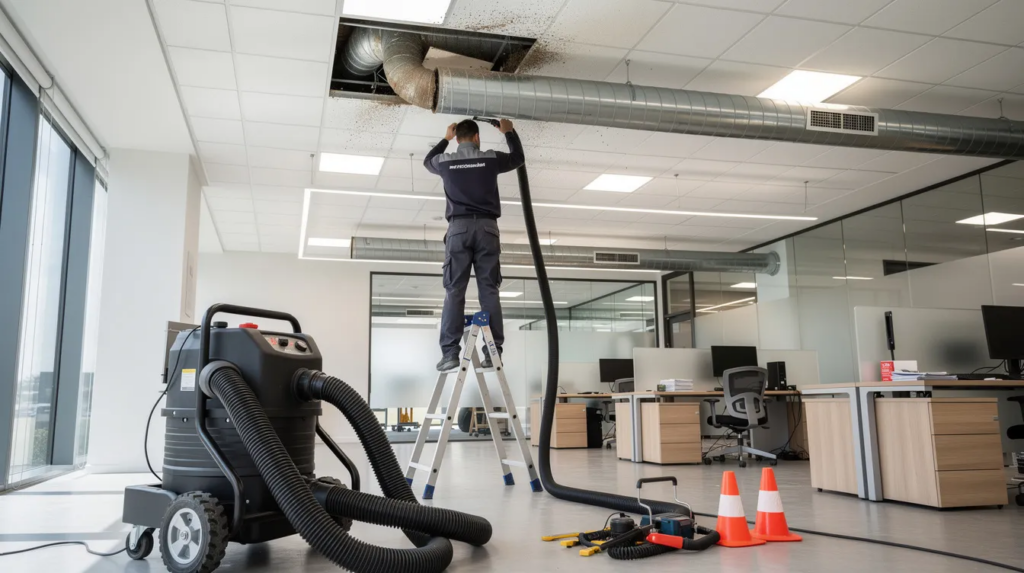
A professional job uses negative pressure, commercial vacuum equipment, brushes, and air whips to remove dust from sheet metal ducts, flex ducts, and main trunks without redistributing particles into occupied offices. This is different from basic vent vacuuming.
Cleaning coils, blowers, and ductwork improves airflow, evens temperature distribution, and helps the system reach setpoints more efficiently. HVAC system performance can be improved, leading to lower energy usage by improving circulation when airflow restrictions are cleared. Proper maintenance of HVAC systems, including regular cleaning, can significantly improve airflow, boost efficiency, and reduce operational costs in both residential and commercial settings.
Regular commercial duct cleaning can significantly improve indoor air quality by reducing dust, allergens, and other contaminants that circulate through occupied spaces. Clean air ducts also reduce dust on surfaces and help improve IAQ for employees, visitors, and customers.
Bee’s Air Duct Cleaning: Commercial HVAC & Air Duct Cleaning Services in Colorado
Bee’s Air Duct Cleaning is a Colorado-based company providing commercial air duct cleaning, commercial HVAC system cleaning, HVAC cleaning, and duct cleaning services across Denver, Colorado Springs, and the Front Range, offering free quotes for cleaner air in Denver and surrounding areas. Learn more at Bee’s Air Duct Cleaning.
Core services include:
Full-system air duct cleaning
Air handler and coil cleaning
Return and supply trunk cleaning
Register and diffuser cleaning
Commercial dryer vent cleaning
HVAC performance evaluation support
Bee’s serves commercial clients such as offices, call centers, schools, universities, medical and dental offices, warehouses, restaurants, hotels, retail stores, and multi-tenant properties.
Our background checked technicians understand rooftop units, VAV systems, large air handling units, and complex commercial air layouts. Commercial cleaning is a highly technical engineering process tailored to complex architectural duct layouts.
Bee’s focuses on complete HVAC system cleaning, not just vacuuming visible vents. NADCA certification indicates that a company has passed rigorous testing covering HVAC mechanics, safety standards, and indoor air quality protocols. To be NADCA certified, air duct cleaning companies must employ certified air system cleaning specialists (ASCS) who have passed a certification examination demonstrating extensive knowledge in HVAC design and cleaning methodologies. A nadca member is required to follow a code of ethics that protects consumers and ensures compliance with industry standard requirements and nadca standards.
Our Commercial Air Duct Cleaning Process for Colorado Buildings
Bee’s designs each service to minimize disruption, with work often scheduled evenings, weekends, overnight, or during school breaks.
The process typically includes:
Facility walkthrough We inspect key air ducts, rooftop units, mechanical rooms, dust streaks, hot/cold spots, and past water intrusion.
System access planning We identify service panels, end caps, diffusers, and where additional access points may be needed and sealed.
Negative-pressure cleaning Commercial-grade vacuum equipment is connected to main trunks, placing the system under continuous negative pressure while brushes and agitation tools loosen dirt and debris.
Component cleaning The following components may be cleaned: coils, blower compartments, registers, diffusers, drain pans, return trunks, and supply trunks.
Optional treatment If mold or microbial contamination is documented, EPA-registered antimicrobial treatment may be recommended and approved before use.
Quality assurance Bee’s can provide before-and-after visual checks, photos or video where feasible, and recommendations for filters, maintenance, replacement concerns, or future inspections.
Commercial Dryer Vent Cleaning for Multi-Unit & High-Volume Facilities
Hotels, student housing, senior living communities, laundromats, and multi-family properties generate heavy lint loads. Regular cleaning prevents neglected ducts and vents from becoming fire hazards, particularly in high-sensitivity environments.
The National Fire Protection Association has reported thousands of dryer-related fires annually, making dryer vent maintenance a safety issue, not just an efficiency task.
Bee’s provides commercial dryer vent cleaning for large-system and multi-unit facilities to improve drying times, reduce energy use, protect equipment life, and lower calls for “broken” dryers that are actually vent-restricted.
How Often Should Colorado Commercial Buildings Schedule Air Duct Cleaning?
Many commercial buildings benefit from duct cleaning every 3–5 years under normal office conditions. NADCA recommends air duct cleaning every three to five years for most homes, but more frequent cleaning may be necessary in certain situations such as having pets or during renovations. While that guidance often applies to a house or living space, commercial schedules depend on occupancy and use.
Higher-risk facilities may need service every 1–3 years, including schools, healthcare facilities, gyms, restaurants, and buildings exposed to wildfire smoke, busy roads, or industrial dust. In mountain communities like Estes Park, air duct cleaning services that improve indoor air quality and HVAC efficiency are especially important due to seasonal occupancy swings and varying outdoor air conditions. In environments with specific health concerns, such as hospitals or food manufacturing facilities, air duct cleaning may need to occur quarterly or semi-annually due to higher contamination risks.
Also schedule inspections after renovations, water damage, roof leaks, extended shutdowns, or when signs that air ducts may need cleaning include excessive dust accumulation on air filters and registers, indicating that contaminants are circulating through the system.
Choosing a Commercial Air Duct Cleaning Partner in Colorado
Commercial air duct cleaning requires specialized equipment, safety practices, and knowledge of large HVAC systems. The lowest-cost provider may not protect your occupants, property, or equipment.
Ask whether the company:
Follows NADCA standards
Carries insurance for commercial work
Uses certified and background checked technicians
Can work safely around clinics, schools, secure offices, and occupied spaces
Provides clear scope, scheduling, dust control, and noise planning
Offers documentation after the job
Bee’s Air Duct Cleaning helps Colorado businesses protect people, property, and budgets with transparent proposals, practical maintenance guidance, and measurable focus on air quality and hvac performance at peak efficiency.
Frequently Asked Questions About Commercial Air Duct Cleaning
Will commercial air duct cleaning disrupt my business operations?
Usually, no. Most projects are scheduled during evenings, overnight hours, weekends, or school breaks. Bee’s coordinates access, staging areas, elevators, tenant notices, and noisy tasks before work begins.
How can I tell if my commercial building actually needs air duct cleaning?
Look for visible dust or streaks on vents, musty odors, uneven heating and cooling, frequent filter loading, and dust returning to surfaces soon after cleaning. Occupant complaints like headaches or allergy symptoms during work hours are also warning signs.
Is commercial air duct cleaning safe for sensitive environments like clinics or schools?
Yes, when performed by trained professionals using containment, HEPA-filtered equipment, and negative pressure. Bee’s technicians are used to working in healthcare, educational, and child-serving environments where safety matters.
Does air duct cleaning replace regular HVAC maintenance and filter changes?
No. Air duct cleaning complements routine maintenance. Filters still need scheduled replacement, and mechanical equipment still needs inspections, belts, controls, refrigerant checks, and tune-ups.
Can commercial air duct cleaning help with lingering odors in my building?
Yes. Removing built-up dust, microbial growth, and debris often reduces musty or stale odors. If moisture, ventilation rates, or hidden contamination are involved, Bee’s can recommend next steps after an on-site evaluation.
Ready to improve indoor air quality, protect your HVAC equipment, and create a cleaner workplace? Contact Bee’s Air Duct Cleaning to schedule a commercial inspection or quote for your Colorado facility.

 Call Now